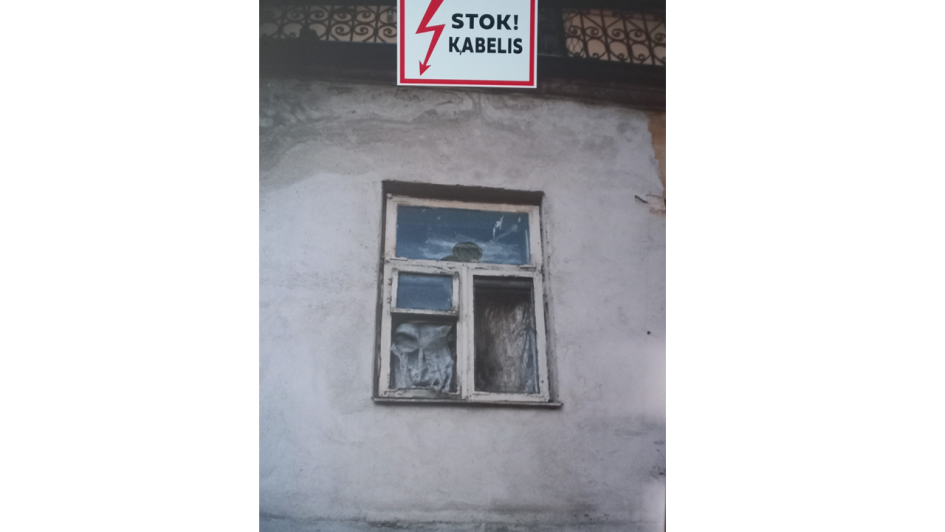
Although many people think that pogroms against Jews are a phenomenon of World War II, the roots of this act of hatred are much deeper. This term „pogrom” began to be used in the 19th century in Tsarist Russia to describe various attacks against Jews. There were more than one such attack in different parts of the Russian Empire. Also, various acts of hatred and violence directed against Jews have been recorded in various cities of Eastern, Western, Central, and Southern Europe, in different countries, and at different times.
The window broken by a stone, captured in the photograph, seems to symbolize the persecutions experienced by Jews in different centuries and countries. The inscription: „STOK K,ABELIS” (en STOP, C,ABLE ) occupies a symbolic place in the work of art. This is an allusion to the Biblical story of two brothers. And who were those who carried out the pogroms – perhaps it was the Jewish neighbor who lived in the next apartment. Maybe for a while, despite their national, cultural, and religious differences, they lived as brothers? But something provoked him and he threw a stone, even though his Jewish neighbor asked him to stop. The work also encourages us to pay attention to those who spread hatred in society, and invites us not to believe their populist, confrontational statements.
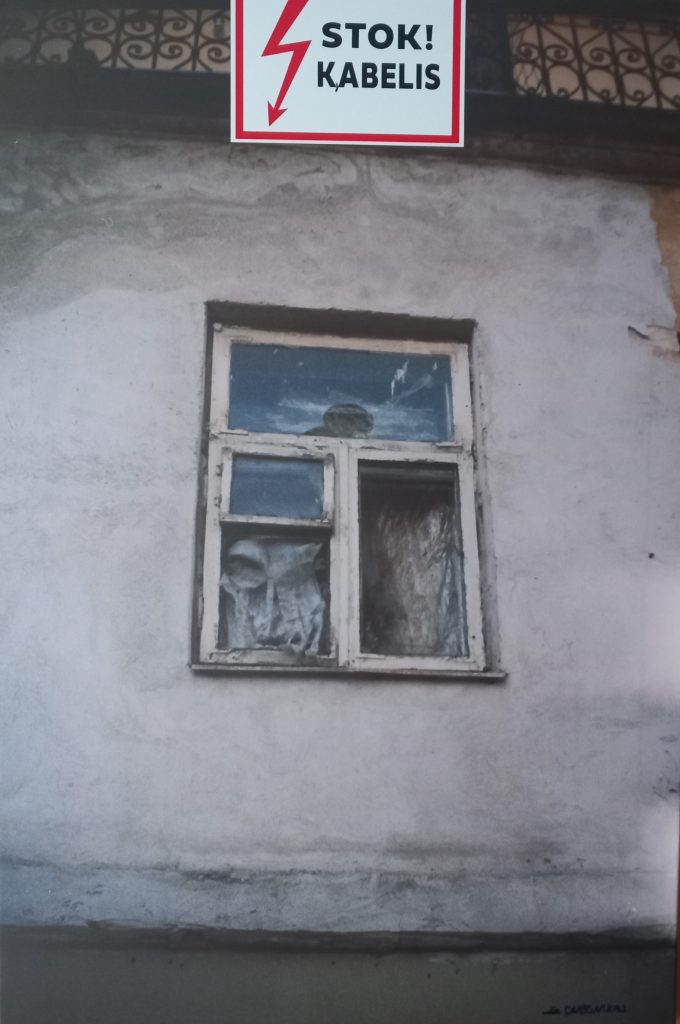
Technology: Horizontal photo canvas 90×60 cm. The photograph was taken on Žemaitijos (formerly M. Strašūnas) street, Vilnius, Lithuania, with a Kodak Hawk Eye camera (made around 1930). The film and development are modern. An information sign „STOP KABELIS” was used.
The art work belongs to the series „M. Strašūnas Street Blues”.